

AsyncAPI 3 support
AsyncAPI 3 changed the way event-driven APIs are described: operations are no longer nested in channels, send and receive replace the ambiguous publish and subscribe, request/reply becomes a first-class pattern, and channels and servers get a clearer structure. Bump.sh now supports AsyncAPI 3 documents: deploy them the same way as your other API documents.
If you didn’t explore this version yet, our AsyncAPI 3 cheat sheet is a good place to start.
Operations first #
In AsyncAPI 3, operations are declared on their own and point to a channel. Your documentation follows the same logic: each operation is listed in an “Operations” section, with a send or receive badge telling your users at a glance whether your application sends or receives the message.
channels:
  tripQuoteRequests:
    address: trips.quotes.requests
    description: Quote requests sent by clients to the pricing service.
    messages:
      tripQuoteRequested:
        $ref: '#/components/messages/TripQuoteRequested'

operations:
  requestTripQuote:
    action: send
    title: Request a trip quote
    channel:
      $ref: '#/channels/tripQuoteRequests'
    messages:
      - $ref: '#/channels/tripQuoteRequests/messages/tripQuoteRequested'
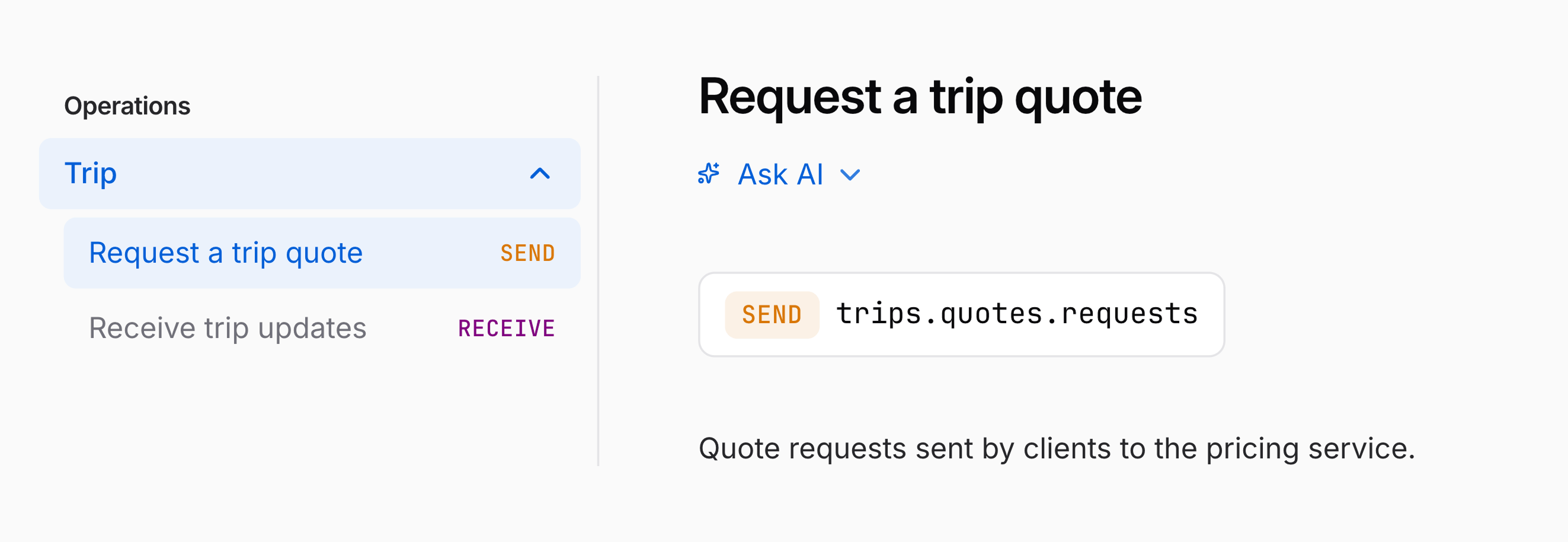
Operations are grouped by tag, or by channel name when they have no tags. All the usual navigation options remain available, including x-tagGroups.
Operation replies #
Many event-driven APIs expect an answer: a client sends a request on a channel and waits for the reply on another one. AsyncAPI 3 describes this pattern natively by adding a reply to the operation.
operations:
  requestTripQuote:
    action: send
    channel:
      $ref: '#/channels/tripQuoteRequests'
    reply:
      channel:
        $ref: '#/channels/tripQuoteReplies'
      messages:
        - $ref: '#/channels/tripQuoteReplies/messages/tripQuote'
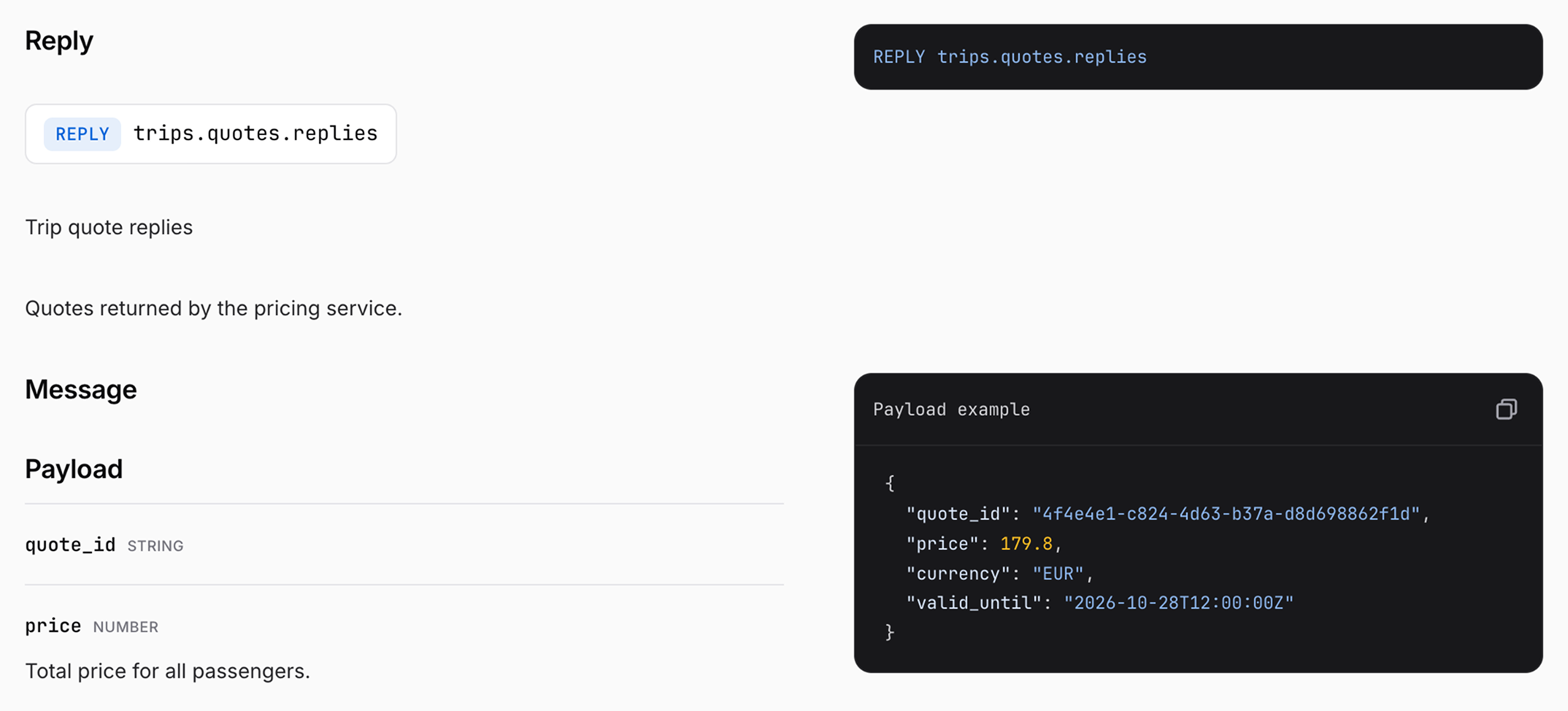
Your documentation now displays this reply: a new “Reply” block appears right below the operation, showing the reply’s address, messages, parameters and bindings. The request and its expected answer are documented side by side.
And more #
- Runtime addresses: a channel without an
addressis displayed as{dynamicAddress}, and a replyaddress.location(e.g.$message.header#/replyTo) is displayed instead of the reply channel address. - Channel messages: when an operation lists no
messages, all the messages of its channel are displayed. titleandsummary: displayed for channels and servers. Operations use theirtitle, or theirsummarywhen no title is set.- Servers: their URL is built from
protocol,hostandpathname. - Traits: operation and message traits are applied following AsyncAPI 3 rules, where a trait never overrides a value already defined on its target.
- External docs: on the
infoobject, servers, operations, channels and messages. - OAuth 2
availableScopes: displayed for each flow, with the scopes required by a security scheme.
The full list of supported fields, and those not supported yet, is available in the help center.
Questions or feedback about AsyncAPI 3? Write to us at hello@bump.sh.