

OpenAPI 3.2: full support
OpenAPI 3.2 brings native answers to needs that used to require vendor extensions: structured navigation, badges, streaming, custom HTTP methods. We started supporting it in December, and every feature it introduces is now rendered in your documentation. Deploy your OpenAPI 3.2 documents as usual, nothing else to set up.
Nested navigation #
Large APIs are easier to browse when operations are grouped by use case. OpenAPI 3.2 lets you build that structure directly in your document, by giving tags a kind and a parent. Tags with kind: nav (or without any kind) build the navigation of your documentation, and parent turns them into a hierarchy:
- a tag used as a
parentbecomes a section of the navigation, titled with its name, - its child tags become the groups of operations listed in that section.
tags:
  - name: Journeys
    kind: nav
  - name: Stations
    kind: nav
    parent: Journeys
  - name: Trips
    kind: nav
    parent: Journeys
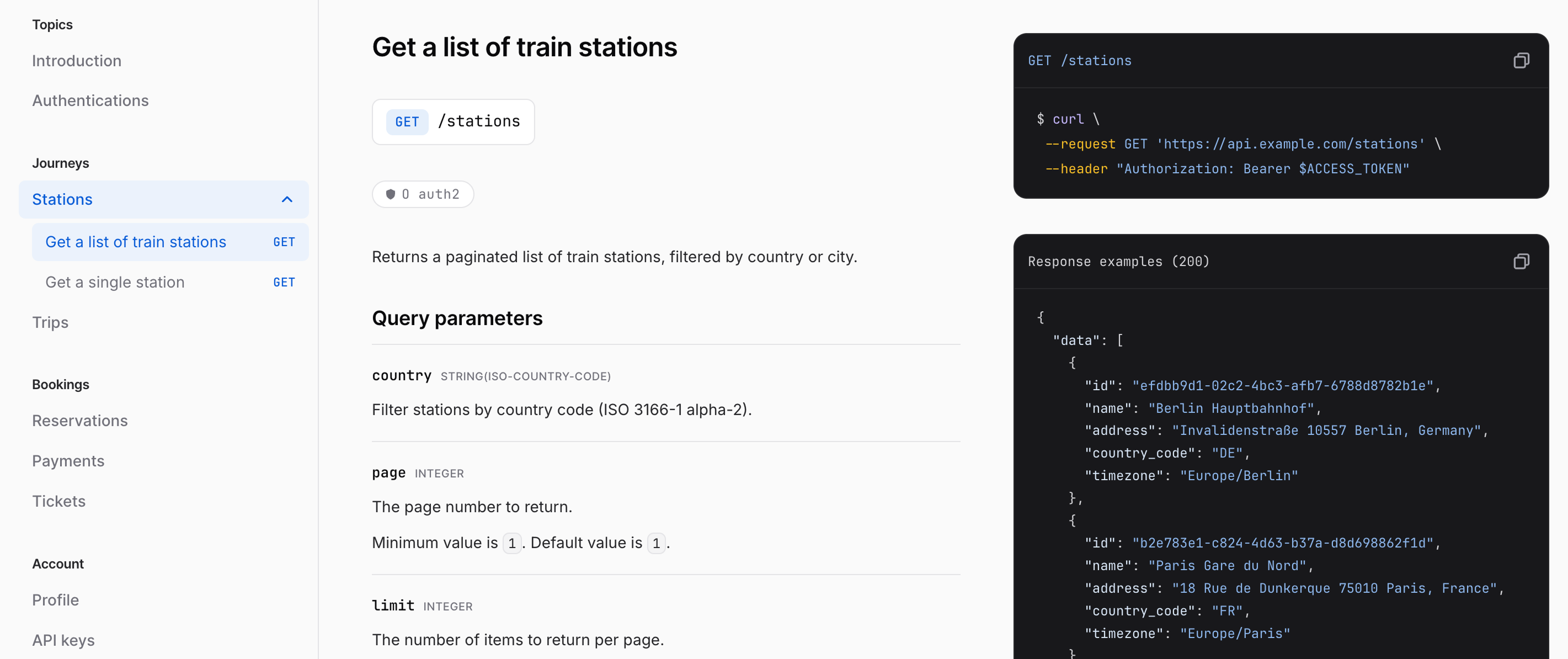
This is the native equivalent of x-tagGroups: when a tag hierarchy is defined, x-tagGroups is ignored. x-tagGroups remains the way to go for OpenAPI 3.1 and below, and for AsyncAPI documents.
Like x-tagGroups, nested navigation requires the “automatic” or “group by tag” grouping mode.
Badges #
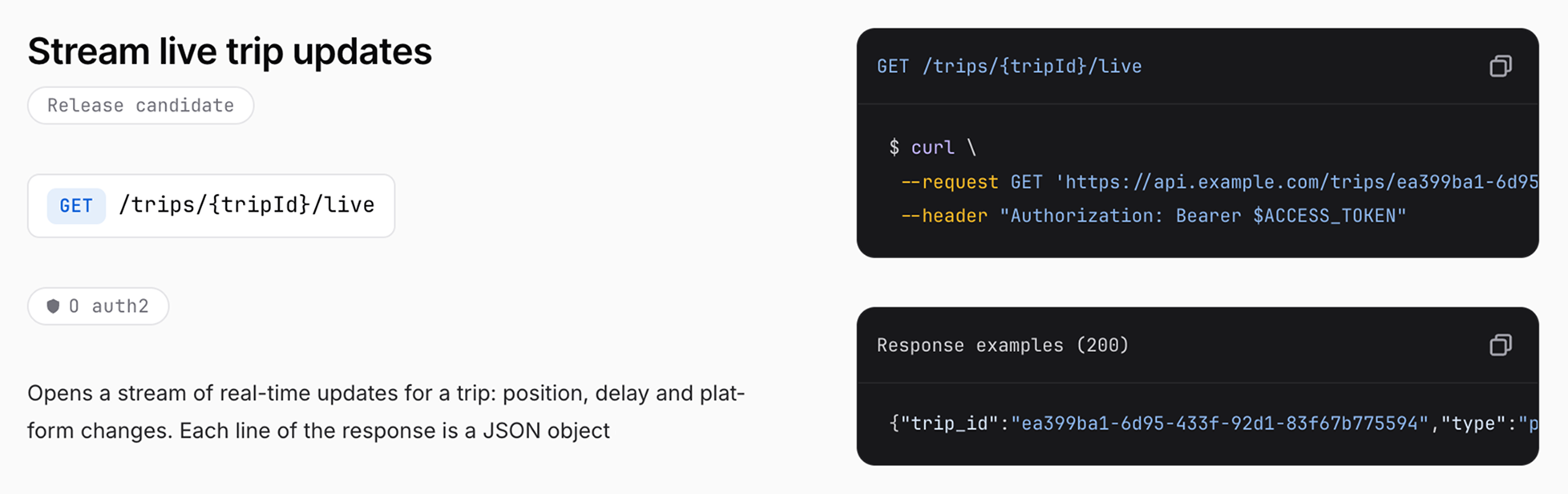
Flag what your users need to know at a glance: a beta feature, a release candidate, an endpoint reserved for some plans. A tag declared with kind: badge adds a badge to every operation or webhook using it. The badge displays the tag name in the default color. More details in the badges help page.
tags:
  - name: Release candidate
    kind: badge

paths:
  /trips/{tripId}/live:
    get:
      summary: Stream live trip updates
      tags: ["Trips", "Release candidate"]
Streaming responses #
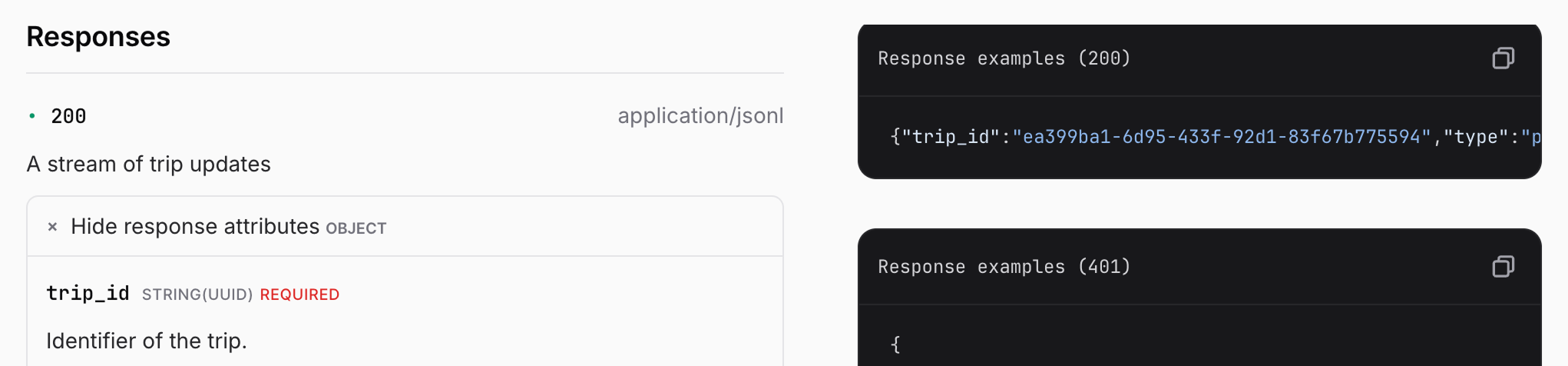
Streaming APIs send a sequence of items instead of a single payload. With itemSchema, your users see the structure of each item, instead of an opaque stream. Learn more in our JSON streaming guide.
responses:
  "200":
    description: A stream of trip updates
    content:
      application/jsonl:
        itemSchema:
          type: object
          properties:
            trip_id:
              type: string
            ...
Any HTTP method #
Some APIs rely on HTTP methods outside the standard list, like PURGE for a cache. With additionalOperations, they are documented like any other operation:
paths:
  /cache/{key}:
    additionalOperations:
      PURGE:
        summary: Purge a cache entry
And more #
- Example
dataValue: the example data before serialization, displayed in request and response examples. - Example
serializedValue: the example as sent over the wire, displayed in request and response examples without reformatting, and used in cURL samples for path, query and header parameters. - Security requirement by URI: a security scheme referenced by a URI (e.g.
#/components/securitySchemes/apiKey) instead of its name, displayed like other security requirements. - OAuth 2
deviceAuthorizationflow: the flow for devices without a browser, displayed with its Device Authorization URL. - OAuth 2
oauth2MetadataUrl: the authorization server metadata URL, displayed in the Authentication section.
They complete the features already supported since December: the QUERY method, tag summary, server name, response summary and deprecated security schemes.
See how each feature is handled in the help center, and dive deeper into OpenAPI 3.2 with our OpenAPI guide.
Any feedback? Reach out at hello@bump.sh.